By Andrew Athineos, Managing Director, Athena Collections®
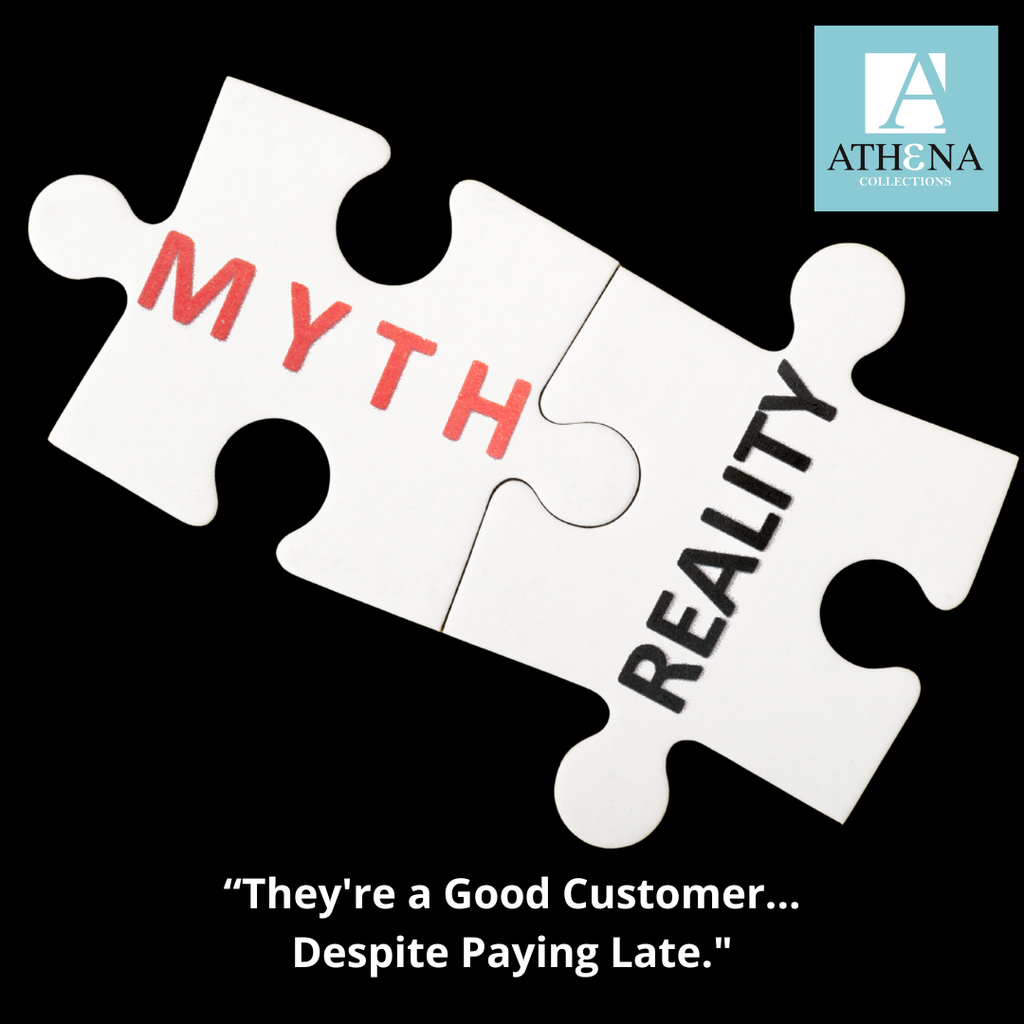
Myths vs Reality
Commercial truths every business owner needs to hear.
The Myth
“They’re a good customer, they just pay late. Every business deals with that”
Do you have a Question for Athena?
Why People Believe It
Revenue is visible and immediate. A steady stream of orders feels like clear evidence of a healthy relationship, and payment timing can seem like a secondary detail by comparison.
Regular orders create a sense of a valuable, established relationship that overshadows the ongoing cash flow problem the lateness quietly causes.
It’s more comfortable to focus on what a customer buys than on what they cost you in financing their delay, especially when they’re polite and easy to deal with in every other respect.
Praise and criticism of the same customer rarely sit easily together, so the lateness gets mentally filed as a minor inconvenience rather than a genuine cost.
The Reality
A customer who reliably orders but consistently pays late isn’t simply a good customer with one small quirk. They may be using your business as working capital, whether that’s intentional or not.
Revenue without timely cash isn’t the same thing as a healthy customer relationship. It’s turnover that costs you money to fund, every single cycle.
The politeness and consistency of the relationship doesn’t offset the ongoing financing cost of the late payment. The two exist independently of each other, and only one of them shows up on your cash flow statement.
“Good customer” and “reliably late payer” are not opposites that cancel each other out. They’re two separate facts, and the second one has a price attached.
The Commercial Impact
The financing cost of chronic late payment is easy to overlook because it doesn’t arrive as a single, visible bill. It’s the overdraft interest, the delayed payments to your own suppliers, and the working capital tied up that would otherwise be available elsewhere.
As an example, a business financing a recurring £30,000 order that’s paid 60 days late, every cycle, at an 8% overdraft rate, is quietly absorbing several hundred pounds in financing cost each time that pattern repeats. Across a year of regular orders, that adds up to a meaningful, entirely avoidable erosion of margin.
“Good” customers with poor payment habits are often the accounts businesses are least willing to challenge, because doing so risks the volume of business they represent. That reluctance means the largest, most consistent risk on the books often goes unaddressed the longest.
Case Study
A business’s largest customer by volume consistently paid 45 to 60 days late on every invoice for over two years. The relationship was valued so highly that credit control never escalated it. When the finance team eventually calculated the actual overdraft cost of financing that customer’s lateness across those two years, it came to a five figure sum, quietly eroding a significant share of the margin the business believed it was earning from the account.
Andrew’s Verdict
Turnover is vanity. Cash is survival. A client who buys regularly but pays badly is not automatically a good client, they may simply be a client who has learned that your business will absorb the cost of their cash flow management. I’ve never advised a business to walk away from a good customer over payment terms. I have advised plenty to sit down and have a direct conversation about what “good customer” is actually costing them.
The Bottom Line
Being a good customer and being a reliably late payer aren’t mutually exclusive, and they shouldn’t be treated as if the first cancels out the second. A customer worth keeping is usually also a customer worth having a direct conversation with about payment terms, precisely because the relationship is worth protecting properly.
Ask yourself: if you costed out exactly what financing your best customer’s late payments actually amounts to over a year, would the number change how you talk to them about terms?
Your first step should be downloading our FREE ULTIMATE GUIDE TO DEBT COLLECTION, a comprehensive resource designed to help you navigate recovery with confidence. We’re here to look at your specific situation and give you the straight facts, even if that means advising you to cut your losses and focus on preventative measures for next time. If you’re looking for a partner to step in, you can easily request a transparent quote via our PRICING PAGE.